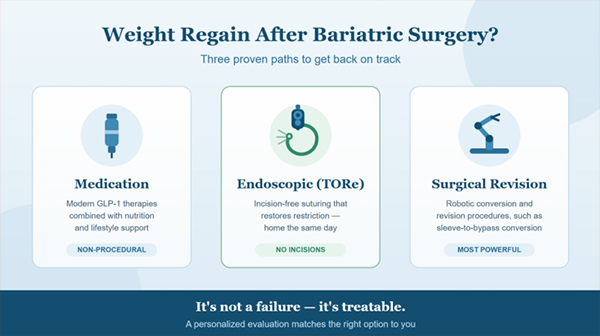
If you’ve regained weight after gastric sleeve or gastric bypass surgery, you’re not alone — and you’re not out of options. Studies show that a significant number of bariatric surgery patients experience some degree of weight recurrence in the years following their procedure. The good news? Weight regain is a recognized, treatable medical condition with more solutions available today than ever before, ranging from modern weight loss medications to incision-free endoscopic procedures and advanced robotic revision surgery.
In this guide from UChicago AdventHealth’s Bariatric and Obesity Medicine Clinic in LaGrange, we’ll walk through why weight regain happens, the full spectrum of revision options, and treatments for other post-bariatric conditions like reflux, dumping syndrome, and reactive hypoglycemia.
Why Does Weight Regain Happen After Bariatric Surgery?
Weight regain after bariatric surgery is not a personal failure — it has real anatomic and physiologic causes:
- Anatomic changes:Over time, the stomach sleeve or gastric pouch can gradually stretch. After gastric bypass, the connection between the pouch and small intestine (the gastrojejunal anastomosis) can dilate, reducing the feeling of restriction and allowing food to empty faster.
- Hormonal adaptation:Hunger and satiety hormones such as ghrelin and GLP-1 shift over the years following surgery, and appetite can return.
- Metabolic adaptation:The body naturally defends against weight loss by lowering energy expenditure.
- Life circumstances:Stress, medications, pregnancy, injury, and other life events can all contribute.
Because the causes are multifactorial, the most effective treatment plans are individualized — which is why a thorough evaluation, often including an upper endoscopy and imaging, is the essential first step.
Option 1: Anti-Obesity Medications After Bariatric Surgery
For many patients, the first-line treatment for post-surgical weight regain is medical, not procedural. Modern anti-obesity medications — including GLP-1 receptor agonists like semaglutide and dual GIP/GLP-1 agonists like tirzepatide — can be highly effective in post-bariatric patients.
Key points:
- Medications work withyour surgical anatomy, enhancing satiety and reducing appetite.
- If your surgery was performed before the GLP-1 era, entirely new treatment options now exist that weren’t available at the time of your operation.
- Medication is combined with structured nutrition counseling and lifestyle support for the best long-term results.
Option 2: Endoscopic Revision — No Incisions, Same-Day Recovery
Endoscopic bariatric revision uses a thin, flexible camera passed through the mouth while you’re comfortably asleep — no incisions, no scars, and most patients go home the same day.
TORe (Transoral Outlet Reduction) After Gastric Bypass
If the outlet between your gastric pouch and small intestine has stretched over time, the TORe procedure uses endoscopic suturing to narrow it back toward its original size. This restores the “full faster” sensation many patients remember from the early months after their bypass, slows pouch emptying, and supports renewed weight loss.
Endoscopic Sleeve Revision
For patients with a dilated sleeve, endoscopic suturing can re-tighten the stomach and restore restriction without repeat surgery.
Benefits of endoscopic revision:
- No incisions and minimal downtime — most patients return to normal activity within days
- Lower risk than reoperative surgery
- Can be combined with weight loss medications for enhanced results
Option 3: Robotic Revision Surgery
When anatomy, symptoms, or the amount of desired weight loss call for it, surgical revision remains the most powerful option. Common revision and conversion procedures include:
- Sleeve-to-bypass conversion— often the best choice for patients with both weight regain and reflux
- Bypass revision— addressing an enlarged pouch or other anatomic issues
- Conversion to duodenal switch or SADI-S— for patients needing greater metabolic effect
These operations are performed using advanced robotic techniques, which allow for smaller incisions, less pain, and faster recovery — even in complex reoperative cases.
Heartburn or Reflux After Gastric Sleeve? You Have Options
GERD (gastroesophageal reflux disease) after sleeve gastrectomy is one of the most common — and most undertreated — long-term issues we see. If acid-reducing medications aren’t controlling your symptoms, or you don’t want to take them indefinitely, effective treatments include:
- The LINX® Reflux Management System— a small ring of magnetic beads placed around the lower esophagus that stops reflux while still allowing you to eat and swallow normally.
- Robotic conversion of sleeve to gastric bypass— the gold-standard operation for severe reflux after sleeve gastrectomy, with the added benefit of supporting further weight loss.
- Hiatal hernia repairv— often performed at the same time, since hiatal hernias frequently contribute to post-sleeve reflux.
Untreated chronic reflux can damage the esophagus over time and, in some patients, lead to Barrett’s esophagus — so an evaluation is worthwhile even if your symptoms feel manageable.
Dumping Syndrome and Reactive Hypoglycemia After Gastric Bypass
Do you experience a racing heart, sweating, nausea, cramping, diarrhea, shakiness, or lightheadedness after meals? These may be symptoms of:
- Early dumping syndrome— rapid emptying of food into the small intestine, typically within 30 minutes of eating
- Reactive (postprandial) hypoglycemia— low blood sugar occurring 1–3 hours after meals, causing shakiness, brain fog, and even fainting
Many patients live with these symptoms for years without realizing treatment exists. Management starts with dietary modification and, when needed, medication. When those aren’t enough, endoscopic therapy with TORe can narrow a dilated outlet and slow pouch emptying — providing durable symptom relief without another operation.
What to Expect at a Revision Consultation
Whether your original surgery was performed at our center or anywhere else — including out of state or internationally — your evaluation begins with a comprehensive, judgment-free workup:
- A detailed history of your surgery, weight journey, and symptoms
- Anatomic evaluation, typically including upper endoscopy and/or imaging
- Nutritional and lab assessment, including vitamin levels
- A personalized recommendation — which may be medication, an endoscopic procedure, surgery, or a combination
Why Choose Dr. Kudsi for Your Bariatric Revision?
Revision and reoperative bariatric surgery is more complex than a first-time operation — experience matters. Dr. Jihad Kudsi brings a combination of credentials and volume that few surgeons in the region can match:
- Double board-certifiedin General Surgery and Obesity Medicine — meaning your surgical and medical weight loss care (including GLP-1 therapy) are managed by the same expert
- High-volume robotic surgeon, performing 150–200 bariatric and foregut procedures each year using the most advanced robotic platforms
- Full spectrum of revision options under one roof— medication, endoscopic procedures like TORe, LINX® anti-reflux surgery, and complex surgical conversions — so the recommendation you receive is based on what’s right for you, not what a practice happens to offer
- National leadership in bariatric quality and safety, including service as an MBSAQIP site reviewer for the nation’s bariatric accreditation program
- Medical Director of Bariatric Surgeryat UChicago AdventHealth’s Bariatric and Obesity Medicine Clinic in LaGrange.
- Welcoming to all patients— including those whose original surgery was performed elsewhere, out of state, or internationally, and those who have been out of follow-up for years
Frequently Asked Questions
Is weight regain after bariatric surgery normal?
Yes. Some degree of weight recurrence is common in the years after gastric sleeve or gastric bypass, and it has real anatomic and hormonal causes. It is a treatable medical condition — not a personal failure.
What is the TORe procedure?
TORe (transoral outlet reduction) is an incision-free endoscopic procedure that uses suturing through a flexible scope to narrow a stretched outlet between the gastric pouch and small intestine after gastric bypass. It restores restriction, slows pouch emptying, and can treat both weight regain and dumping syndrome. Most patients go home the same day.
Can I take GLP-1 medications like semaglutide or tirzepatide after bariatric surgery?
In most cases, yes. GLP-1 and dual-agonist medications are frequently used in post-bariatric patients and can be very effective for weight regain, under the supervision of an experienced obesity medicine team.
What can be done for severe heartburn after gastric sleeve?
Options include acid-reducing medication, hiatal hernia repair, the LINX® magnetic anti-reflux device, and robotic conversion of the sleeve to a gastric bypass, which is considered the gold-standard operation for severe post-sleeve reflux.
What causes shakiness, sweating, or a racing heart after meals following gastric bypass?
These are classic symptoms of dumping syndrome or reactive hypoglycemia (low blood sugar after eating). Both conditions are treatable — starting with dietary changes and medication, and in selected patients, the endoscopic TORe procedure.
Is revision surgery riskier than the original operation?
Reoperative surgery carries somewhat higher risk than a first-time operation, which is why it should be performed by an experienced, high-volume revision team using robotic techniques. For many patients, a medication or endoscopic option may achieve their goals without reoperation.
Will insurance cover bariatric revision?
Coverage varies by plan and by indication. Revisions for medical complications such as severe reflux, dumping syndrome, or hypoglycemia are often covered. Our team will help verify your benefits before any procedure.
Do I need to have had my original surgery at your center?
No. We welcome patients whose surgery was performed anywhere — including other states or countries — and patients who have been out of follow-up for years.
Bariatric Revision Near Chicago’s Western Suburbs
UChicago AdventHealth’s Bariatric and Obesity Medicine Clinic in LaGrange proudly serves patients throughout Chicagoland and the western suburbs, including Oak Brook, Hinsdale, La Grange, Burr Ridge, Downers Grove, Westmont, Willowbrook, Darien, Western Springs, Clarendon Hills, Elmhurst, Lombard, Naperville, Wheaton, Bolingbrook, and Woodridge. If you’re searching for bariatric revision surgery, the TORe procedure, or treatment for reflux after gastric sleeve near you, expert help is close to home — and telehealth consultations are available for your first visit.
Take the Next Step
If you’ve regained weight or are living with reflux, dumping syndrome, or low blood sugar after bariatric surgery, help is available at UChicago AdventHealth’s Bariatric and Obesity Medicine Clinic in LaGrange. Schedule a consultation to learn which option — medication, endoscopic revision, or robotic surgery — is right for you.
Book online at DoctorKudsi https://www.doctorkudsi.com, or call the LaGrange Bariatric Clinic at (708) 245-5425 or Duly Health and Care at 630-790-1700